



Technical Services logo with red banner and blue swoosh accents
249 VAN Launch Kit 249 VAN Consumer Brochure Smart Thermostat Sell Sheet 249 VAN Launch Kit

Unlock the Full Potential

View Quick Start Guide

This installation was on a 4-story home, and the tech had not yet gone to the basement to troubleshoot the “infinity” water source heat pump, as he was told he by the homeowner. He was in the attic at the infinity furnace above the 4th floor. He was getting his dcv in the proper range on his A and B green plug on the air handler, 3 to 4 vdc. His indoor board ohm reading was in range, 28k to 32 k. The tech ohmed out the A and B thermostat wires on the water source heat pump from the upstairs. His ohm reading was not in range of a normal infinity board. His reading was around 64.4k. The tech then made the long walk to the basement where the “geothermal heat pump” was located. Bingo. 

Picture of Bubba Moore

Bubba Moore

Technical Services Manager Southeast District

March 10, 2022

Isolating the Problem in The Unit

There are many ways to diagnose problems with a unit. You can listen to the customer describe the operations of the unit, and you can observe the operations for yourself. Then comes the time when you have to get your tools and meters to start checking why some parts of the unit are working, or why nothing is working.


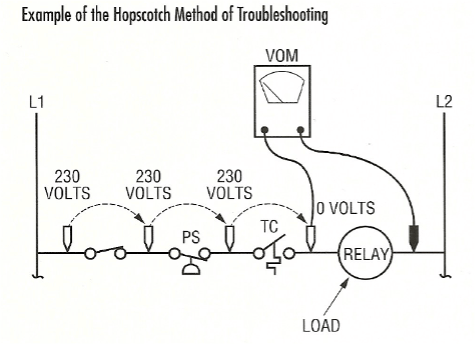
One way of checking out why a motor or compressor is not working is the Hopscotch Troubleshooting Method. Hopscotching is a way of testing for voltage readings across components in the circuit that is not working. You would place one meter lead on one side of the unit’s line voltage or control voltage, depending on what was not working. For example, let’s say the motor is not running: place one meter lead on one side L2 going to the motor, then you would take the other meter lead and put it on L1 going to the motor before any components that this wire would connect to. Let’s say your voltage is 230v at this point, as you move your meter lead that is on L1 to the next place (the other side of a contactor or relay switch) leaving the other meter lead on the L2 and not moving it. This is how you hopscotch through to the controls to the part that is not working. When the meter lead that is testing the L1 side does not read 230v, that is where the problem is.

Diagram of a troubleshooting method showing a voltmeter testing a relay circuit between L1 and L2, with 230V and 0V points.

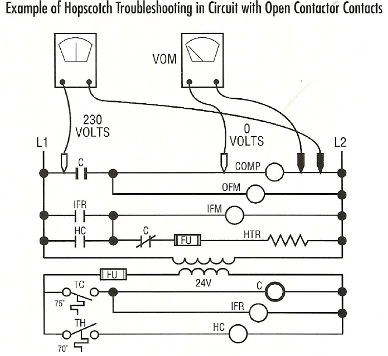
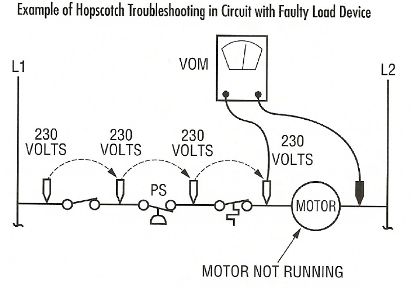
There may be burnt out points on a contactor, and/or the relay switch didn’t close due to being stuck open. If you had 230v at the motor, you probably have a motor that failed, but the process of hopscotching confirmed that there were no problems with the controls before the motor. The same process can be used to check the control voltage that turns on the components.


This is just one way to isolate problems with components within the equipment. You can use the hopscotch method in troubleshooting resistive loads like crankcase heaters or heater elements, as well as inductive loads such as relay coils, solenoid coils, and transformers. It can also be used to check switch contacts as in low/high pressure switches, contactors or relays, etc. This method allows you to check the complete circuit from start to the end.

Electrical troubleshooting diagram for open contactor contacts with voltmeter readings and labeled circuit components.

Hopsotch troubleshooting circuit diagram with voltmeter and motor not running, showing 230V points along a line

Sources:


HVAC SERVICING PROCEDURES

249 VAN Launch Kit 249 VAN Consumer Brochure Smart Thermostat Sell Sheet 249 VAN Launch Kit

Unlock the Full Potential

View Quick Start Guide

This installation was on a 4-story home, and the tech had not yet gone to the basement to troubleshoot the “infinity” water source heat pump, as he was told he by the homeowner. He was in the attic at the infinity furnace above the 4th floor. He was getting his dcv in the proper range on his A and B green plug on the air handler, 3 to 4 vdc. His indoor board ohm reading was in range, 28k to 32 k. The tech ohmed out the A and B thermostat wires on the water source heat pump from the upstairs. His ohm reading was not in range of a normal infinity board. His reading was around 64.4k. The tech then made the long walk to the basement where the “geothermal heat pump” was located. Bingo. 


More to Explore

Family relaxing in a bright living room, parents on a gray couch with laptops while children play nearby
By Austin Sims August 4, 2026
At Mingledorff's we understand your business. We are your #1 HVAC and plumbing distributor choice. Trust our experience. Contact us today!
Mingledorffs
By Jenny Reed August 4, 2026
At Mingledorff's we understand your business. We are your #1 HVAC and plumbing distributor. Trust our experience. Contact us today!
Bright hobby shop with display cases, counter, and model kits; a few people stand near the back.
By Jenny Reed August 3, 2026
At Mingledorff's we understand your business. We are your #1 HVAC and plumbing distributor. Trust our experience. Contact us today!

Bright hobby shop interior with display cases, model kits, and a counter with two people inside.
By Jenny Reed August 3, 2026
At Mingledorff's we understand your business. We are your #1 HVAC and plumbing distributor. Trust our experience. Contact us today!


Heat Pump

Keep up with the latest HVAC news from Mingledorff’s Inc.