
Technical Services logo with red banner and blue swoosh accents
249 VAN Launch Kit 249 VAN Consumer Brochure Smart Thermostat Sell Sheet 249 VAN Launch Kit

Unlock the Full Potential

View Quick Start Guide

This installation was on a 4-story home, and the tech had not yet gone to the basement to troubleshoot the “infinity” water source heat pump, as he was told he by the homeowner. He was in the attic at the infinity furnace above the 4th floor. He was getting his dcv in the proper range on his A and B green plug on the air handler, 3 to 4 vdc. His indoor board ohm reading was in range, 28k to 32 k. The tech ohmed out the A and B thermostat wires on the water source heat pump from the upstairs. His ohm reading was not in range of a normal infinity board. His reading was around 64.4k. The tech then made the long walk to the basement where the “geothermal heat pump” was located. Bingo. 

2. The second in SEER sequence is the HP 20 SEER/ AC 20.5 SEER. It has two nicknames: Greenspeed/ Extreme & 1st Gen Greenspeed/ 1st Gen Extreme. It is recognized by have the inverter at the top in a black box, with 3 items below it: control board, transformer, and a contactor.


  • Inverter made by Emerson
  • Typically, 40%-100% all variable
  • Scroll compressors
  • Outdoor fan motor is ECM
  • Model numbers: 25VNA0/ 24VNA0 & 280ANV/180CNV

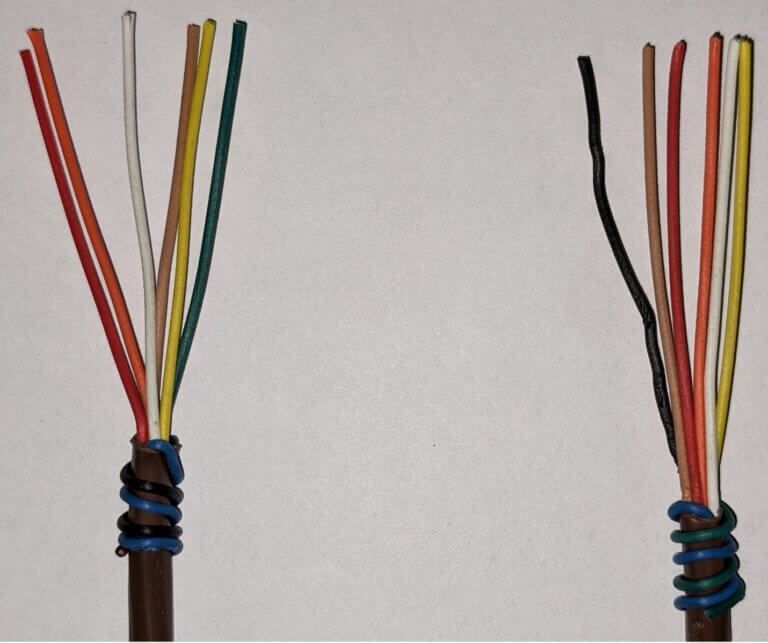
Now get out there and organize some zone wiring!

Zone equipment would be identified as indoor unit- blue black/ outdoor unit-blue green:
Two multicolored wire bundles with exposed ends and wrapped bases on a white background
Smiling man in a gray collared shirt on a white background

Bubba Moore

Technical Services Manager Southeast District

June 1, 2020

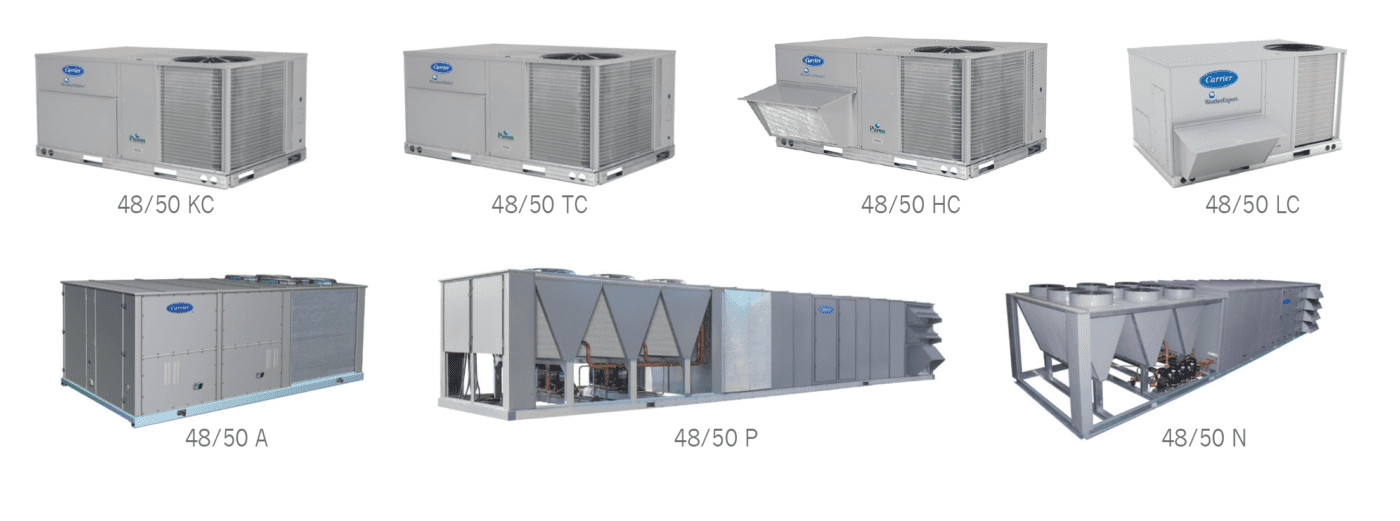
Humidi-MiZer® Adaptive Dehumidification Systems – 48-50 TC/HC Packaged Units

Humidi-MiZer®


Packaged rooftop units are being used in many applications today not only for cooling but for comfort and humidity control. Indoor space humidity levels can be increasingly difficult to control depending on the time of year, location and the ability of the equipment to provide flexible operations to meet indoor part load, sensible and latent load requirements. Carrier’s Humidi-MiZer® Adaptive Dehumidification System is designed to meet these requirements. The Humidi-MiZer® unit’s will respond based on the temperature and humidity requirements as sensed in the space. This is achieved by a thermostat with a built in humidity sensor (thermidistat) or a separate thermostat with a humidistat.


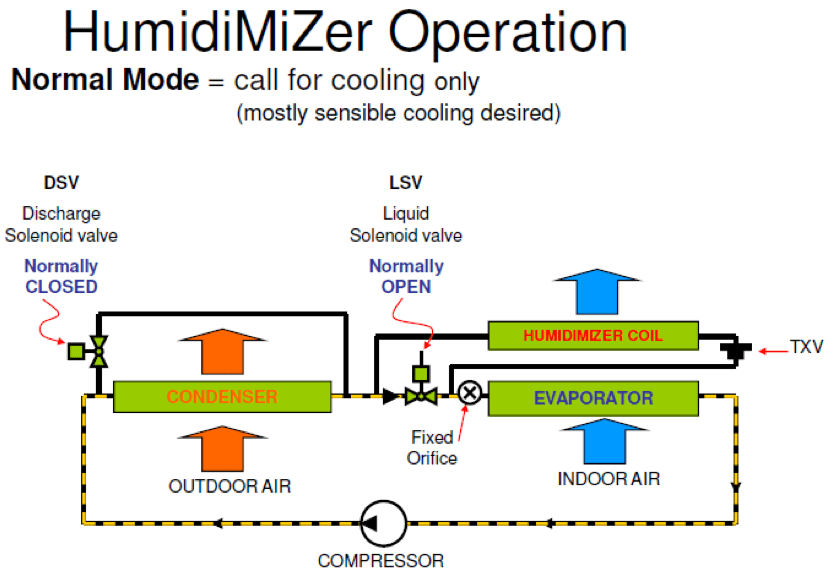
The Humidi-MiZer unit’s operational flexibility to maintain year round indoor comfort and humidity levels is due to its three operational modes and the controls that help achieve it. There is a liquid line solenoid valve and a discharge gas solenoid valve that open and close to direct refrigerant depending on the operational mode of the Humidi-MiZer unit.


The cooling mode provides sensible and latent cooling from the evaporator coil. During the cooling demand only the liquid line solenoid valve is de – energized and open(NO), the discharge gas solenoid valve is closed (NC). In the cooling mode only the system performs like any other package A/C unit.

Humidi-MiZer®

HumidMiZer operation diagram showing compressor, condenser, evaporator, and airflow in normal cooling mode

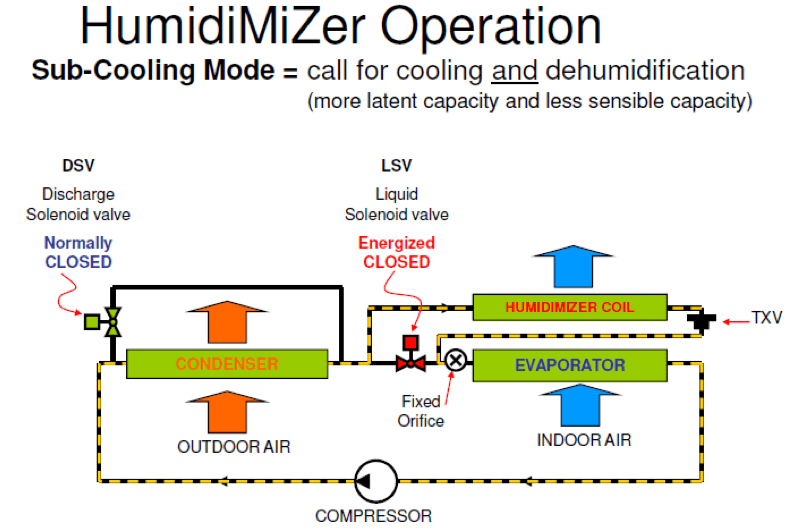
These Humidi-MiZer units transition from cooling to subcooling mode as humidity rises in the space which is determined by a thermidistat or a humidistat device. This subcooling mode will cause the liquid solenoid valve to energize causing the valve to close and redirect all hot liquid refrigerant to flow in to the Humidi-MiZer coil. Where it is exposed to cold supply air flowing through the evaporator coil. The liquid is subcooled to a temperature close to the evaporator leaving air temperature. As the subcooled liquid leaves the Humidi-MiZer coil it passes through a thermostatic expansion valve (TXV) causing the liquid to drop to a lower pressure. The TXV does not have a pressure drop great enough to change the liquid to a two phase fluid, so the liquid is directed into a fixed metering device at the evaporator coil.


The liquid enters the evaporator coil at lower temperature than in normal cooling mode. The increased subcooling causes the evaporator coil temperature to decrease, thus increasing the unit’s latent cooling effect (up to 40%). During the subcooling mode the discharge gas solenoid valve is de – energized and closed.

HumidiMizer operation diagram showing humidification/cooling airflow through condenser and evaporator units

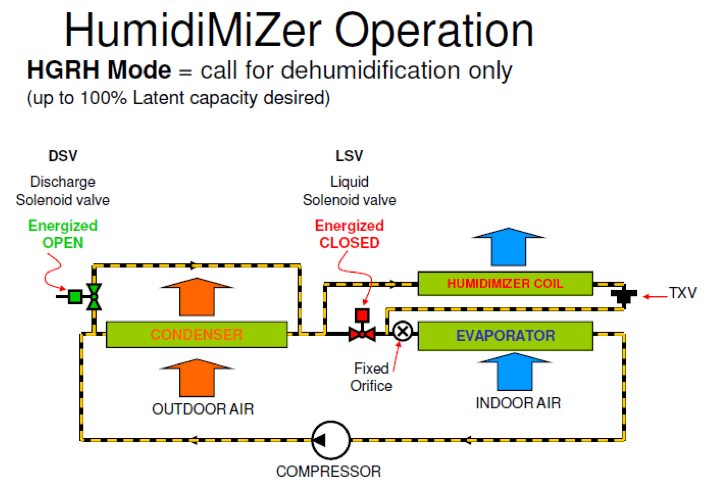
The third mode of the Humidi-MiZer unit is when there is only a demand for dehumidification, the system will operate in Hot Gas Reheat mode. The reheat control board will energize the compressor and supply fan motor. The liquid solenoid valve will be energized closed and the discharge gas solenoid will be energized open. This hot gas will mix with liquid refrigerant leaving the condenser coil and flow to the Humidi-MiZer coil. The conditioned air coming off the evaporator coil will be cooled and dehumidified. The heat from the bypassed discharge gas offsets the sensible cooling effect from the evaporator coil during hot gas reheat mode. This will warm the evaporator leaving air to a neutral condition between 72 and 75 degrees.

HumidiMizer operation diagram showing heating and cooling airflow, compressor, condenser, evaporator, and valves

The Humidi-MiZer Adaptive Dehumidification System can be used in many applications, such as in Schools, Restaurants, Health Clubs, etc. The adaptive dehumidification system allows for dual humidity control mode in the unit, because of the subcooling/reheat dehumidification coil located downstream of evaporator coil. This innovative design provides the capability for the unit to operate in both a subcooling mode and a hot gas reheat mode for maximum system flexibility.

Collage of gray modular HVAC units and large rooftop air conditioning systems.
249 VAN Launch Kit 249 VAN Consumer Brochure Smart Thermostat Sell Sheet 249 VAN Launch Kit

Unlock the Full Potential

View Quick Start Guide

This installation was on a 4-story home, and the tech had not yet gone to the basement to troubleshoot the “infinity” water source heat pump, as he was told he by the homeowner. He was in the attic at the infinity furnace above the 4th floor. He was getting his dcv in the proper range on his A and B green plug on the air handler, 3 to 4 vdc. His indoor board ohm reading was in range, 28k to 32 k. The tech ohmed out the A and B thermostat wires on the water source heat pump from the upstairs. His ohm reading was not in range of a normal infinity board. His reading was around 64.4k. The tech then made the long walk to the basement where the “geothermal heat pump” was located. Bingo. 


More to Explore

Family relaxing in a bright living room, parents on a gray couch with laptops while children play nearby
By Austin Sims August 4, 2026
At Mingledorff's we understand your business. We are your #1 HVAC and plumbing distributor choice. Trust our experience. Contact us today!
Mingledorffs
By Jenny Reed August 4, 2026
At Mingledorff's we understand your business. We are your #1 HVAC and plumbing distributor. Trust our experience. Contact us today!
Bright hobby shop with display cases, counter, and model kits; a few people stand near the back.
By Jenny Reed August 3, 2026
At Mingledorff's we understand your business. We are your #1 HVAC and plumbing distributor. Trust our experience. Contact us today!
Bright hobby shop interior with display cases, model kits, and a counter with two people inside.
By Jenny Reed August 3, 2026
At Mingledorff's we understand your business. We are your #1 HVAC and plumbing distributor. Trust our experience. Contact us today!

Heat Pump

Keep up with the latest HVAC news from Mingledorff’s Inc.