

Unlock the Full Potential
This installation was on a 4-story home, and the tech had not yet gone to the basement to troubleshoot the “infinity” water source heat pump, as he was told he by the homeowner. He was in the attic at the infinity furnace above the 4th floor. He was getting his dcv in the proper range on his A and B green plug on the air handler, 3 to 4 vdc. His indoor board ohm reading was in range, 28k to 32 k. The tech ohmed out the A and B thermostat wires on the water source heat pump from the upstairs. His ohm reading was not in range of a normal infinity board. His reading was around 64.4k. The tech then made the long walk to the basement where the “geothermal heat pump” was located. Bingo.

May 1, 2020
Commercial Defrost Control
The Commercial Defrost Control Board (DFB) can be confusing and misunderstood. This DFB does a lot more than just control defrost. The DFB coordinates thermostat demands for first and second stage cooling, first and second stage heating, emergency heating and HVAC defrost control. The DFB also has an indoor fan off delay.
The DFB does not need an O or B signal to determine whether the reversing is energized in heating or cooling. That is why the units that use this DFB do not use a standard heat pump thermostat. When the DFB receives a call for first stage cooling the reversing valve(s) are energized (not by second stage cooling) and stay energized even after the demand for cooling is no longer needed. On a demand for heating the reversing valve(s) are de-energized and (stay de-energized until a call for cooling) the compressor(s) are started for first stage heating. On a call for second stage heating the DFB will energize the auxiliary (electric) heat control. The DFB also controls the auxiliary heat control during emergency heating and defrost.
HVAC Defrost Process
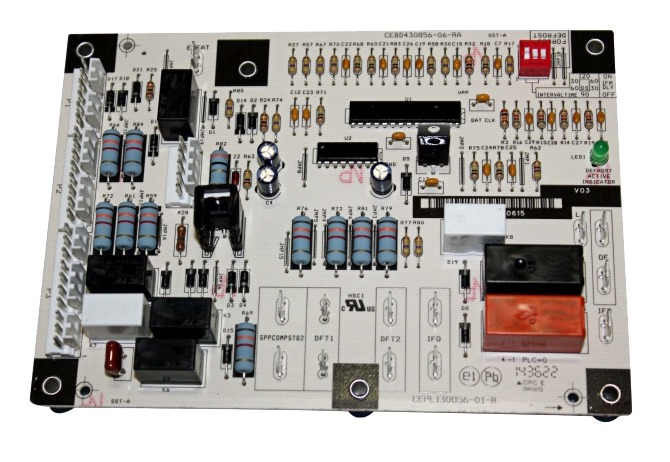
Part# HK32EA005
The DFB when controlling defrost is a time /temperature sequence. The time is adjustable with dip switches: these times are 30, 60, 90 and 120 minutes. These times are not all the same depending on the tonnage of the equipment. The temperature function is provided by defrost thermostat(s). The tonnage will determine if the system has one or two defrost thermostats. Units with one defrost switch will defrost when the timing period is completed and the defrost switch is closed. The defrost period will end when the defrost thermostat opens, or a ten-minute time has lapsed. The larger tonnage systems have two defrost thermostats and the sequence of operations is different. Defrost thermostat number one cannot initiate a defrost cycle, only defrost thermostat number two can initiate a defrost. The DFB monitors defrost switch number one and will allow it to defrost once circuit two is in defrost. Circuit one will stay in defrost until switch opens or if circuit two defrost cycle is terminated. If space temperature is satisfied before defrost is completed, the DFB will remember where the defrost cycle was interrupted and on restart of a heating call it will resume defrost operations.
The DFB also has a defrost speedup function: this can be done by shorting across two jumper wires that are marked on the DFB. If the defrost switches are closed and you short these jumpers for one to three seconds, it reduces the defrost time period. If the jumpers are shorted for five to twenty seconds, the DFB goes into a forced defrost and will function like a normal defrost if the defrost thermostat(s) are closed. If the defrost thermostat(s) are open, the defrost cycle will run for thirty seconds and terminate.
The DFB can be set up to allow the indoor fan to run for sixty seconds after the system shuts down if the space thermostat fan switch is set to auto. The fan delay begins when a heating or cooling demand is satisfied.
As you can see, this DFB can do a lot more than just monitor an iced up coil. The function of this DFB with input signals from the thermostat is that it controls the cooling and heating sequences, defrost stages, and aides the technician in speeding up a defrost, or checking out the defrost functions. And to top it all off, you can have a delayed fan if needed.
Unlock the Full Potential
This installation was on a 4-story home, and the tech had not yet gone to the basement to troubleshoot the “infinity” water source heat pump, as he was told he by the homeowner. He was in the attic at the infinity furnace above the 4th floor. He was getting his dcv in the proper range on his A and B green plug on the air handler, 3 to 4 vdc. His indoor board ohm reading was in range, 28k to 32 k. The tech ohmed out the A and B thermostat wires on the water source heat pump from the upstairs. His ohm reading was not in range of a normal infinity board. His reading was around 64.4k. The tech then made the long walk to the basement where the “geothermal heat pump” was located. Bingo.
More to Explore

Heat Pump
Keep up with the latest HVAC news from Mingledorff’s Inc.